
What Causes A Toilet To Rock When You Sit On It
A toilet that rocks when you sit on it is telling you something is wrong underneath the fixture, and the problem almost never fixes itself. Most homeowners in Cedar Park and the surrounding areas notice the movement gradually, starting with a slight shift and progressing to a noticeable wobble that makes the whole bathroom feel unstable. The rocking usually comes down to one of four causes: an uneven floor, loose or corroded closet bolts, a failed wax ring, or a damaged closet flange sitting below the finished floor. Each of those causes carries a different level of urgency, and a couple of them lead directly to water damage in the subfloor if they go unaddressed for too long. The good news is that a rocking toilet is one of the more straightforward problems a licensed plumber handles, and catching it early keeps the repair small. The bad news is that a wobbling toilet slowly breaks the seal that keeps sewer gas and wastewater contained beneath the bowl, so waiting rarely saves money. Understanding what is actually moving down there helps you describe the problem accurately and make a smart decision about repair. This guide walks through the real mechanical causes, what each one means for your floor and your plumbing, and when the fixture needs professional attention.
Why a Toilet Rocks When You Sit On It
Toilets are designed to sit flat and rigid against the finished floor, anchored by two closet bolts that thread up through the closet flange and clamp the porcelain base down. When everything is installed correctly, the base makes even contact with the floor across its full footprint, and the wax ring underneath compresses into a watertight seal between the toilet horn and the drain. Any gap in that contact, any looseness in the anchoring, or any weakness in the flange itself will show up as movement the moment your body weight shifts onto the seat. The rocking you feel is the porcelain pivoting on a high spot or flexing against a bolt that no longer holds tension. Because porcelain does not bend, all of that stress transfers into the wax ring, the flange, and the floor underneath. That is why a small wobble that seems harmless today can turn into a slow leak that rots the subfloor over the next several months. Identifying which of the underlying causes applies to your bathroom is the first step toward a repair that actually lasts.
An Uneven Floor Causes a Toilet to Rock When You Sit On It
Floors are rarely perfectly level, and bathrooms are some of the worst offenders in any house. Tile installations in particular create small variations in height where grout lines meet, where thinset was troweled unevenly, or where a tile sits slightly proud of its neighbors. A toilet base is a rigid ring of vitrified porcelain that will only make contact at the three or four highest points on that surface, and once weight is applied, the fixture rocks between those contact points. Vinyl and laminate flooring can create the same issue in a different way, because the old flooring is frequently cut around the toilet rather than under it, leaving the base straddling a small step in floor height. Homes in Central Texas that have gone through a bathroom remodel are especially prone to this, since a new tile layer raises the floor without anyone adjusting the flange height to match. The movement may be small at first, but each use of the fixture works the base against those contact points and gradually wears them down.
Shimming is the standard correction for an uneven floor, and it is more precise work than most people expect. Plastic toilet shims are tapered wedges that slide under the base at the low points until the fixture sits solid in every direction, and a plumber checks that solidity by applying pressure at multiple points around the rim rather than just pushing on the tank. Once the toilet no longer moves, the shims get trimmed flush with a utility knife and the visible gap around the base is sealed with a bead of silicone caulk. That caulk serves an important purpose beyond appearance, because it keeps mop water and shower splash from wicking under the base and sitting against the subfloor. Plumbing code in most jurisdictions calls for the base to be sealed to the finished floor, with a deliberate gap left at the rear so any leak from the wax ring becomes visible instead of hiding. Cutting corners on the shimming step means the toilet will loosen again within a few months.
There is an important distinction between shimming a toilet and simply cranking down the closet bolts to force the base flat. Porcelain has almost no give, and overtightening a bolt on an unsupported base concentrates all of that force on a small area of the china. Hairline cracks form around the bolt holes, and those cracks spread every time someone sits down until the base fails outright, sometimes suddenly and with water on the floor. Plumbers tighten closet bolts to snug and no further, then rely on shims to carry the load in the gaps. If a toilet in your home was previously repaired by someone who simply tightened the bolts down hard, it is worth having the base inspected for stress cracks before the fixture is put back into regular service. Need a toilet repaired or reset the right way? Click here for our toilet repair service.
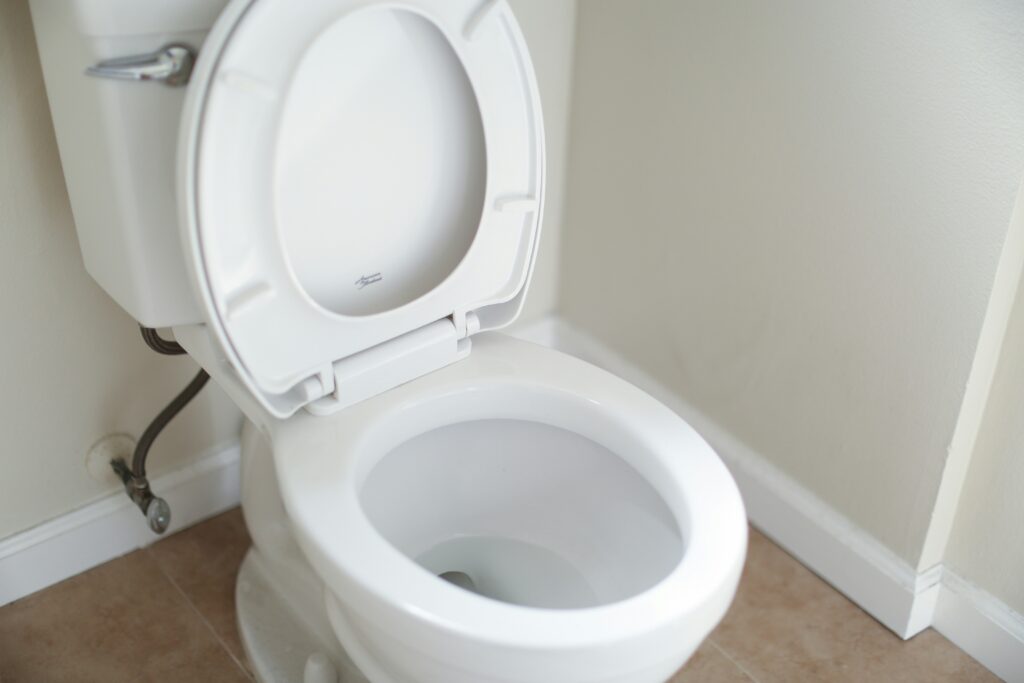
Loose or Corroded Closet Bolts Cause a Toilet to Rock When You Sit On It
The two closet bolts that hold a toilet down are the entire mechanical connection between the fixture and the drain system, and they take more abuse than people realize. Every time someone sits, stands, or leans, the bolts absorb a shifting load, and over years of that cycling the nuts back off slightly or the bolts themselves elongate. Standard closet bolts are brass for a reason, since brass resists the corrosion that comes with a humid bathroom environment and occasional contact with water. Contractors and homeowners sometimes substitute cheaper zinc-plated steel bolts, and those rust from the inside out, losing strength long before the exterior looks bad. When a bolt corrodes enough, the nut spins freely without tightening, and the toilet is essentially resting on the floor with nothing holding it down. That is the point where the wobble becomes obvious and the fixture starts to shift side to side under load.
Replacing closet bolts requires pulling the toilet, which means shutting off the supply, disconnecting the supply line, draining the tank and bowl, and lifting the fixture clear of the flange. It is a job that goes smoothly when the flange is in good condition and turns complicated when it is not, because a corroded bolt frequently means moisture has been present around the flange for a long time. A plumber removes the old bolts from the flange slots, installs new solid brass bolts with the heads seated properly in the keyhole openings, and often adds retaining washers to hold the bolts vertical while the toilet is set. That small detail matters, since a bolt that leans over during the set will not come through the base hole cleanly and the entire fixture has to be lifted again. Getting the bolts plumb and the toilet dropped straight down onto the wax ring in one motion is what makes the seal hold.
Bolt problems often come with a second symptom worth mentioning to your plumber. If the toilet also runs, gurgles, or drains slowly in addition to rocking, the movement may have already compromised the seal and disturbed the connection to the drain line. A toilet that has been rocking for months has been flexing the wax ring with every use, and wax does not recover its shape once it has been worked. In those cases a bolt replacement alone is not the full repair, and the wax ring, and sometimes the flange, need to be addressed at the same time. Since the fixture has to come up either way, doing the complete job in one visit costs far less than repeating the process later. A plumber can also inspect the subfloor around the flange while the toilet is off, which is the only reliable way to catch early water damage before it spreads.
A Failed Wax Ring Causes a Toilet to Rock When You Sit On It
The wax ring is a molded seal that sits between the bottom of the toilet and the top of the closet flange, and it compresses when the fixture is set to form a watertight and gastight connection. Wax works well for this because it conforms to irregular surfaces and stays pliable indefinitely under normal conditions, but it has no structural strength whatsoever. A wax ring is not designed to hold a toilet up or absorb movement, and it fails quickly when the fixture rocks. Once the wax has been worked open, wastewater from every flush finds the gap and seeps out onto the flange and the surrounding subfloor. Sewer gas escapes through the same opening, which is why a persistent bathroom odor with no visible source frequently traces back to a bad wax ring. The leak volume is usually small enough that water never appears on the finished floor, and that is exactly what makes it dangerous.
Water that escapes at the flange goes directly into the subfloor, and in most Texas homes that subfloor is plywood or OSB sheathing. Those materials absorb moisture readily and lose structural integrity as they stay wet, softening around the flange until the flange itself no longer has solid material to fasten into. At that point the toilet rocks worse, which opens the seal further, which leaks more water, and the cycle accelerates. Homeowners often first notice the problem as a soft or spongy feeling in the floor near the toilet, or as staining on a ceiling below if the bathroom is on a second story. Repairs at that stage go well beyond a wax ring, and can involve cutting out and replacing sections of subfloor, replacing the flange, and repairing the finished flooring. Every month that a rocking toilet goes unrepaired increases the odds of ending up in that situation.
Replacing a wax ring is a routine job when the surrounding materials are still sound. The toilet gets pulled, the old wax is scraped completely off both the flange and the toilet horn, and the flange is inspected for cracks, corrosion, and proper height relative to the finished floor. A new ring is set, the toilet is lowered squarely onto it without shifting sideways, and the closet bolts are tightened evenly in alternating turns. Some plumbers prefer wax-free seals for certain applications, particularly where a flange sits low or where the toilet may need to come up again in the future. Either way, the repair only holds if the underlying rocking problem is corrected at the same time, because a new seal under a moving toilet fails just as fast as the old one did. Dealing with a bathroom odor or a suspected leak under a fixture? Click here for our leak detection service.
What a Rocking Toilet Means for Your Floor and Drain System
A rocking toilet is a fixture problem on the surface and a plumbing problem underneath, and the connection between the two is what makes it worth taking seriously. The closet flange is a fitting that is glued or fastened to the top of the drain pipe and mechanically anchored to the floor structure, and it is the piece that ties your toilet into the home’s drain, waste, and vent system. When a toilet moves, that movement transfers straight into the flange, and flanges are not built to handle repeated lateral force. Cast iron flanges in older homes crack at the bolt slots; PVC flanges break at the ring or pull their screws out of a weakened subfloor. Once the flange fails, there is nothing holding the toilet in position and nothing maintaining the seal to the drain. Understanding how the flange, the subfloor, and the drain line work together makes it much clearer why a small wobble deserves a call rather than a wait-and-see approach.
A Damaged Closet Flange Causes a Toilet to Rock When You Sit On It
The closet flange sits at the top of the toilet drain and is supposed to rest on top of the finished floor, not below it, with the toilet base sealing against a ring that is properly supported from beneath. When a bathroom is retiled without adjusting the flange, the flange ends up recessed below the new floor height, and the wax ring has to span a gap it was never designed to fill. That gap allows the toilet to rock even when the bolts are tight, because the fixture is effectively balancing on the finished floor while its drain connection sits lower. Flange extender rings solve this problem correctly by building the flange back up to the proper height and providing a solid surface for the seal. Stacking multiple wax rings is a common shortcut that seems to work at first, but the extra wax has no support and squeezes out under load. Any toilet installed after a flooring change should have the flange height verified as part of the job.
Cracked flanges are the other major failure, and they show up most often in homes where a toilet has been rocking for a long time or where the fitting has been through repeated removals. Cast iron flanges corrode at the bolt slots, and the thin metal around those slots eventually gives way, leaving the bolt with nothing to grab. PVC flanges crack at the ring or break where the screws pass through, particularly if the subfloor beneath has softened from a slow leak. A plumber diagnoses this by pulling the toilet and inspecting the full circumference of the flange, checking both the bolt slots and the attachment to the floor. Repair options range from a stainless steel repair ring that reinforces a partially damaged flange to a complete flange replacement, which involves cutting into the drain line and installing a new fitting. The right approach depends on the flange material, the condition of the pipe below it, and how much the surrounding floor structure has been affected.
Flange repairs are one of the clearest cases where professional work pays off, because the flange is the interface between a fixture and the sanitary drain system. An improperly repaired flange leaks wastewater under the floor, allows sewer gas into the living space, and can put the drain connection out of alignment enough to cause slow flushing or repeat clogs. In slab foundation homes, which are common throughout Cedar Park, Leander, Round Rock, and the greater Austin area, the drain line runs through the concrete, and flange work has to be done without disturbing that connection. That takes proper tools and experience with the specific fitting types used in slab construction. A licensed plumber also knows when a flange issue is actually a symptom of something larger in the drain line, which is information no amount of guesswork will produce.
Subfloor Damage Follows a Toilet That Rocks When You Sit On It
Subfloor damage is the expensive outcome of an ignored rocking toilet, and it develops quietly. Water escaping a compromised wax ring wicks into the plywood or OSB around the flange opening and stays there, since there is no airflow under a toilet base and no path for the moisture to evaporate. The wood swells, delaminates, and loses the ability to hold a screw, which is precisely the material the flange depends on for anchoring. Homeowners typically discover this when the toilet suddenly becomes much looser than it was, or when a foot pressed near the base produces a soft or flexing feeling in the floor. In second story bathrooms, the first sign is often a stain or a bubble in the ceiling paint of the room below. By that point the damage has been developing for months or longer.
Assessing subfloor damage requires pulling the toilet and examining the wood directly, and often probing the material with a tool to find the full extent of the softening. Damage confined to a small ring around the flange can sometimes be addressed with a repair ring that spans onto solid material, while more extensive rot requires cutting out and replacing the affected sheathing. That work has to account for the joists underneath, since a cut has to land on solid framing to be properly supported, and it often means removing and replacing finished flooring in the area. The cost difference between catching a rocking toilet early and repairing a rotted subfloor is substantial, frequently by an order of magnitude. This is the specific reason plumbers push homeowners not to wait on a wobbling fixture.
There is a health dimension to this as well that is worth stating plainly. Wastewater leaking under a floor introduces bacteria into an enclosed, dark, consistently damp space, and mold growth follows in that environment. Bathrooms in Central Texas homes deal with high humidity for much of the year, which accelerates the process considerably. Sewer gas escaping through a failed seal contains methane and hydrogen sulfide, and while the concentrations from a small leak are generally low, the persistent odor is a real quality of life issue in a home. None of this is a reason for alarm over a toilet that has just started to move slightly, but all of it is a reason to handle the repair sooner rather than later. A fixture that is caught early is a straightforward reset; one that is ignored becomes a floor project.
Drain Line Problems Can Make a Toilet Rock When You Sit On It
Less commonly, a rocking toilet points to an issue in the drain line itself rather than in the fixture or the floor. Slab foundation movement, which is a genuine and well-documented concern across Central Texas due to the expansive clay soils in the region, can shift a drain line and put stress on the flange connection above it. When that happens, the flange may be pulled out of level or partially separated from the pipe, and no amount of shimming the toilet will produce a stable, sealed installation. Signs that point in this direction include a toilet that has been reset properly but loosens again quickly, visible cracking in the floor tile near the fixture, or drain issues affecting multiple fixtures in the same area of the house. These situations need a diagnosis that goes below the floor before any fixture work is done.
A plumber investigating this will typically start by pulling the toilet and inspecting the flange to pipe connection, then may run a camera down the drain line to see the condition and alignment of the pipe. Camera inspection shows separated joints, offsets from foundation movement, bellied sections holding standing water, and root intrusion in older lines, all of which affect how the system drains and how the fixture above it performs. That information determines whether the correct fix is a flange repair at the surface or a repair to the line below. Doing it in the right order avoids paying for a fixture reset that fails within weeks because the actual problem was never addressed. It also gives you accurate information about the condition of your drain system, which matters for planning.
Older properties in the Austin metro deserve particular attention here, since cast iron drain lines have a service life and many homes in the area are now well past the point where those pipes were installed. Cast iron corrodes from the inside, scales up, and eventually develops holes at the bottom of the pipe where waste sits, and the deterioration frequently shows up first at the flange, which is the most exposed point in the system. A toilet that rocks in a home with original cast iron plumbing warrants a look at the pipe condition, not just the fixture. That kind of assessment gives you the ability to plan for a repipe on your own schedule rather than reacting to an emergency. Concerned about the condition of your drain lines or slow-draining fixtures? Click here for our drain cleaning service.
Why You Need a Licensed Plumber for a Rocking Toilet
A rocking toilet looks like a simple fix, and in the best case it is, but the range of underlying causes means the diagnosis matters more than the repair itself. Shimming a toilet that has a cracked flange, or replacing bolts on a fixture sitting over a rotted subfloor, produces a repair that fails and leaves the real problem developing underneath. A licensed plumber pulls the fixture, sees the actual condition of the flange, the seal, and the floor, and fixes what is genuinely wrong. That approach costs the same as a guess on the front end and considerably less over the life of the bathroom. Whitestone Plumbing handles toilet resets, flange repairs, and wax ring replacements throughout Cedar Park and the surrounding communities, and we tell homeowners exactly what we find.
What a Professional Toilet Repair Includes for a Rocking Toilet
A proper service call for a rocking toilet starts with pulling the fixture, because everything relevant to the diagnosis is hidden underneath it. Once the toilet is off, the flange gets inspected for cracks, corrosion, proper height, and secure attachment to the floor structure. The subfloor around the opening is checked for softening and staining, the old wax is removed completely from both surfaces, and the drain opening is examined for anything that would affect the connection. Only after that assessment does the actual repair get determined, and the homeowner gets a clear explanation of what was found before any work proceeds.
The repair itself depends on what the inspection reveals, and it may involve new brass closet bolts, a new wax or wax-free seal, a flange repair ring, a flange extender to correct height, or shims to compensate for an uneven floor. The toilet is set squarely onto the new seal, the bolts are tightened evenly and to the correct tension, and the fixture is checked for movement in every direction before the supply is reconnected. The base is caulked to the finished floor per code, with a deliberate gap at the rear. The toilet is then tested through multiple flush cycles to confirm the seal holds and the fixture drains correctly.
Documentation and honest reporting are part of the job. If the inspection turns up subfloor damage, flange failure, or a drain line issue that goes beyond the fixture, you should hear about it clearly, along with what it means and what your options are. If the repair is simple and the underlying components are in good shape, you should hear that too, without an upsell attached. That transparency is what separates a service call from a sales call. Need a toilet reset, or thinking about replacing an old fixture entirely? Click here for our toilet installation service.
When a Rocking Toilet Becomes an Emergency Plumbing Situation
Most rocking toilets are not emergencies, and a fixture that has developed a slight wobble can generally be scheduled for a normal service appointment. The situation changes when water appears on the floor around the base, when the fixture shifts dramatically or feels like it could tip, or when a soft spot has developed in the surrounding floor. Those symptoms mean the seal has already failed and water is actively getting into the structure, and every day of continued use adds to the damage.
Cracked porcelain is the other genuine emergency, and it is worth knowing what to look for. Hairline cracks around the closet bolt holes or across the base can propagate suddenly under load, and a toilet base that fails while someone is sitting on it is both a safety hazard and an immediate water event. If you see any cracking in the porcelain of a toilet that also rocks, stop using that fixture and shut off the supply valve behind it. That single step prevents the worst version of the outcome.
Whitestone Plumbing offers 24/7 emergency plumbing service throughout our service area, and a failed toilet at an inconvenient hour is exactly the kind of call we handle. Shutting off the supply valve behind the fixture stops the flow of clean water, and avoiding further flushes limits what comes out of the drain side. Call us at (512) 826-6217 and we will get someone out. Dealing with an active leak or a fixture that has failed? Click here for our burst pipe repair service.
Why Choose Whitestone Plumbing for Your Rocking Toilet Repair
Whitestone Plumbing is a locally owned and operated company based at 702 Dewberry Dr in Cedar Park, and we have been serving homeowners across Central Texas for over 20 years. Our technicians are licensed and insured, and we hold backflow licensing and certification as well. That experience means we have seen every version of a rocking toilet, from a simple shim job on uneven tile to a full flange replacement in a slab foundation home. We diagnose accurately because we have done the work enough times to recognize what we are looking at.
We provide free estimates with clear, honest pricing, and we explain what we find before we start. Homeowners deserve to understand the condition of their plumbing and to make decisions with real information rather than pressure. If your toilet needs a wax ring and nothing more, that is what we will tell you and that is what we will charge for. If the flange or subfloor needs attention, you will see the problem and understand why the repair is necessary.
We serve Cedar Park, Round Rock, Leander, Georgetown, Pflugerville, Austin, Lago Vista, Jonestown, and Hudson Bend. Call (512) 826-6217 or email info@callwhitestone.com to schedule a visit. We are dedicated to providing 5 star service on every job, and a rocking toilet is a problem we can solve quickly and correctly.