
How Often Should You Flush Your Water Heater
Most water heaters in Cedar Park need a flush once a year, and plenty of them need one every six months because of the hard water running through Central Texas homes. Sediment settles at the bottom of a tank every single time the burner or the elements heat the water, and that layer keeps growing until somebody drains it out. The result is slower recovery, a noisier tank, and a shorter service life on equipment that should comfortably last a decade or more. Fall is the right season to handle this, since demand on your water heater climbs as soon as incoming water temperatures start to drop. A tank that already struggles in September will struggle far more in January, when the heater has to close a much wider temperature gap on every cycle. This guide covers how often to flush your water heater, what shortens that schedule, and what actually happens inside a tank that never gets drained. It also covers the point where a flush stops being routine maintenance and starts being a repair decision.
How Often to Flush a Water Heater in Central Texas Hard Water
The standard recommendation from tank manufacturers is one full flush every twelve months, and that number assumes average water quality. Cedar Park water is harder than average because it comes out of limestone country, carrying dissolved calcium and magnesium that drop out of solution the moment the water gets heated. Your tank collects mineral solids faster than an identical tank installed in a soft water region, which is why the manufacturer interval is a floor rather than a target. Homes with heavy hot water demand accumulate sediment faster still, since every gallon heated leaves a little more behind on the bottom of the tank. For that reason, many homes in this area do better on a six month cycle than a yearly one. Tankless equipment follows a completely different rule, and we cover that below.
How Often to Flush a Tank Water Heater Each Year
A conventional tank water heater should be drained and flushed at least once every twelve months. Manufacturers print that interval in the owner manual, and they print it because sediment is the leading cause of premature tank failure in residential plumbing. A forty or fifty gallon tank serving a family of four heats thousands of gallons across a year, and every one of those gallons leaves behind a trace of mineral content that stays in the tank. Over twelve months that trace turns into a measurable layer of grit spread across the tank floor. Draining while the layer is still loose removes most of it through the drain valve without much effort at all. Wait three or four years and the same material hardens into a crust that no longer rinses out with water pressure alone. The annual interval exists specifically to catch sediment while it still moves.
Several conditions push that interval down to six months. Hard water is the biggest factor, and homes across Cedar Park, Leander, and Round Rock receive water on the harder end of the scale year round. Household size is the second factor, since a home running two showers, a dishwasher, and a laundry cycle daily pushes far more water through the tank than a couple living in a small house. Homes on a private well often see the fastest accumulation of all, because well water can carry sand and iron along with dissolved minerals. Tanks older than eight years also benefit from the shorter schedule, since they already hold years of accumulated material and need more frequent attention just to stay clear. A home with a properly maintained water softener can usually stay on the annual schedule, provided the resin is doing its job and the brine tank stays full. Skipping softener salt for a season quietly puts your water heater right back on the faster track.
Fold the flush into a broader yearly checkup instead of treating it as an isolated chore. While the tank is draining, it makes sense to test the temperature and pressure relief valve, confirm the thermostat sits near 120 degrees, and look at the flue condition on a gas unit. The anode rod deserves inspection every three to five years, because that sacrificial rod is the only part protecting bare steel from corrosion. A rod that has dissolved down to the core wire leaves the tank exposed, and no amount of flushing reverses rust once it takes hold. Checking the drain valve itself matters too, since the inexpensive plastic valves used on many builder grade units tend to weep after they have been opened. One appointment covers every one of those items in a single visit. That is why a full annual service protects the equipment far better than a flush by itself. Want a full checkup on your system before winter? Click here for our water heater inspection service.

How Often to Flush a Tankless Water Heater for Scale Control
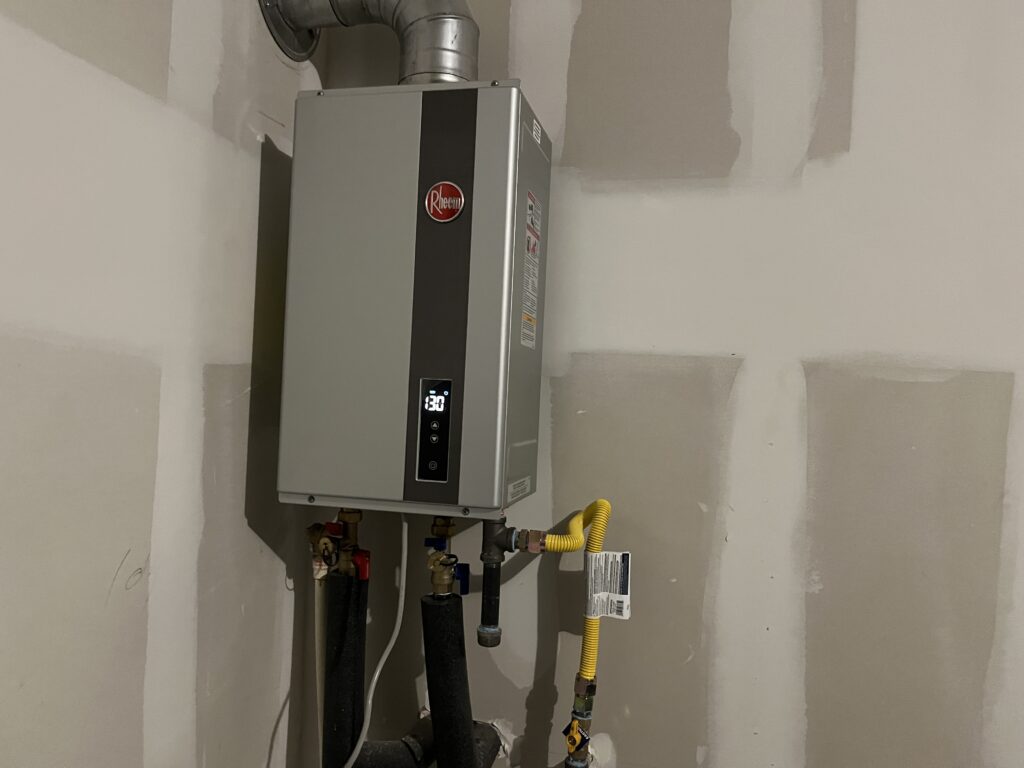
Tankless units hold no reservoir of standing water, so homeowners often assume they never need service. The opposite is true in a hard water region. A tankless heat exchanger raises water temperature very quickly across a narrow copper or stainless passage, and rapid heating is exactly the condition that drives calcium out of solution. That mineral bonds directly to the walls of the exchanger as scale. Even a thin coating restricts flow and forces the burner to work harder to reach the temperature you set. Manufacturers call for a descaling flush every twelve months as a baseline recommendation. Around Central Texas, every six to nine months is the realistic interval for most homes running without a softener.
The tankless flush works nothing like a tank flush. A technician closes the isolation valves, connects hoses to the service ports, and circulates a descaling solution through the heat exchanger with a small pump for roughly forty five minutes. The solution dissolves the mineral deposits and carries them out of the unit into a bucket. Clean water then rinses the loop, and the inlet screen filter comes out for cleaning as well. The entire process takes about an hour on a unit that already has isolation valves installed. Units without those valves take considerably longer, because the plumber has to add the valves before any flush can happen. Anyone installing a tankless system should insist on isolation valves from day one for exactly this reason.
Ignoring the tankless schedule produces a very specific set of symptoms. Hot water starts arriving at a lower flow rate, since scale narrows the passage the water has to travel through. Temperature begins swinging during long showers as the unit fights to hold its setpoint against the restriction. Error codes tied to flow rate or overheating start appearing on the display panel. Left long enough, scale creates hot spots that can crack the heat exchanger, and a replacement exchanger costs a large share of what the unit cost new. Most tankless warranties also require documented annual maintenance, so a neglected unit can lose its coverage at the exact moment it needs that coverage most. Regular descaling costs a small fraction of any of those outcomes.
Considering a tankless system or need yours serviced? Click here for our tankless water heater page.
Signs You Are Overdue to Flush Your Water Heater
Sound is the first clue most homeowners notice. A tank that pops, rumbles, or crackles during a heating cycle has sediment on the bottom trapping small pockets of water against the hot steel. Those pockets flash to steam and force their way up through the layer, which produces the knocking noise people usually describe as popcorn popping inside the tank. The sound itself is harmless, yet it tells you the layer has grown thick enough to insulate the burner from the water sitting above it. On an electric unit, sediment covering the lower element produces a similar sizzling or humming sound during operation. Either noise means the flush is already overdue. Acting at that point still saves the tank in most situations.
Water quality changes are the second clue. Rusty or brown hot water that runs perfectly clear on the cold side points to material inside the tank rather than a problem with the municipal supply. Cloudy water carrying fine white or tan particles that settle to the bottom of a glass usually means calcium flakes are breaking loose and traveling into your fixtures. Those flakes clog faucet aerators, shower heads, and the small inlet screens inside washing machine valves. A rotten egg smell in the hot water points to a bacterial reaction with the anode rod, and a flush paired with an anode replacement usually clears it up. None of these symptoms improve on their own with time. Each one gets steadily worse as the layer at the bottom of the tank continues to build.
Performance loss is the third clue and the one households notice most directly. Showers run out of hot water sooner than they used to, and recovery between showers takes noticeably longer than it once did. The gas bill or the electric bill creeps upward without any change in how the family uses water. All three symptoms trace back to the same root cause, since a layer of sediment sits between the heat source and the water it is supposed to be heating. A tank carrying an inch of buildup loses a real share of its usable capacity, because that volume now holds rock instead of water. Flushing restores the capacity, but only in cases where the material still drains freely. Hardened sediment sometimes leaves replacement as the only remaining option.
What Happens When You Skip a Water Heater Flush
Sediment does not sit quietly at the bottom of the tank doing nothing. It changes how the appliance behaves, how much energy it consumes, and how many years it survives. A tank engineered for ten to twelve years of service can fail in six when nobody ever drains it. The damage accumulates gradually, which is exactly what makes it so easy to ignore until the failure announces itself as water spreading across the garage floor. Understanding the mechanism behind that failure explains why the flush schedule carries so much weight. Here is what a skipped flush actually costs a homeowner.
How Sediment Buildup Shortens Water Heater Life
On a gas water heater, the burner sits directly beneath the bottom of the tank and heats the steel from below. Water on the other side of that steel carries the heat away and keeps the metal at a safe operating temperature. Sediment interrupts that transfer completely. The layer functions as insulation, so the flame keeps firing while the steel underneath climbs well past the temperature it was designed to tolerate. Overheated steel weakens, and the glass lining bonded to the interior of the tank develops fine cracks under the thermal stress. Once that lining cracks, water reaches bare steel and corrosion begins immediately. That is the direct path from a missed flush to a leaking tank, and it typically takes a few years to run its course.
Electric water heaters fail differently but just as reliably. The lower heating element sits a few inches above the tank floor, right in the zone where sediment naturally collects. As the layer rises past that element, the element ends up buried in mineral solids instead of surrounded by circulating water. It scorches, burns out, and stops producing heat entirely. The upper element keeps working, which is why homes with a buried lower element still get hot water but only about half the volume they expect. Replacing that element without flushing the tank simply drops a new part into the same failing environment. The replacement burns out again, sometimes within a single year.
Corrosion accelerates in both types of tank. Sediment holds moisture and dissolved minerals tight against the tank floor, creating small zones where the water chemistry differs from the rest of the vessel. Those zones corrode faster than the surrounding steel, and the anode rod cannot protect a surface it sits buried beneath. A tank that would have reached twelve years with routine care starts leaking at seven or eight instead. Tank failures rarely give advance warning; the seam simply opens and forty or fifty gallons head straight for the lowest point in the house. A unit installed in an attic or an interior closet turns that failure into a ceiling repair and a flooring claim. Routine flushing remains one of the very few maintenance tasks that measurably extends the working life of the equipment.
How a Missed Water Heater Flush Raises Energy Bills
Every layer between the heat source and the water costs you energy. A gas burner firing through half an inch of hardened calcium has to run considerably longer to raise the same fifty gallons to the same temperature. That extra runtime shows up on the utility bill month after month without any obvious explanation. Scaled water heating equipment loses meaningful efficiency even with modest deposits, and the loss grows right along with the thickness of the layer. Homeowners rarely connect the change to the water heater, since the increase arrives slowly across several billing cycles rather than all at once. The water heater is often the second largest energy consumer in the house, sitting behind heating and cooling. Small percentage losses applied to a load that size add up to real money over a year.
Recovery time suffers alongside efficiency. Recovery describes the rate at which a tank reheats after the hot water has been drawn down. A clean fifty gallon gas unit recovers fast enough to handle back to back showers on a busy morning. The same unit carrying a sediment layer takes substantially longer, because the heat has to work its way through the deposit before it ever reaches the water. Households respond by turning the thermostat up, which raises standby losses and increases the risk of scalding at the tap. Running above 120 degrees also speeds up mineral deposition, since hotter water drops calcium out of solution more aggressively. The workaround quietly makes the underlying problem worse.
Winter magnifies every one of these effects. Incoming water from the main arrives colder in December than it does in August, sometimes by twenty degrees or more depending on the year. The heater has to close a much wider temperature gap on every single cycle, so runtime climbs even on a perfectly healthy unit. Add a sediment layer to that equation and the gas bill jumps while the hot water still runs short during evening showers. This is exactly why fall is the best time to schedule a flush, ahead of the season that puts the heaviest load on the system. A tank cleaned in September enters the cold months operating at full capacity. A tank cleaned in February spent the entire winter working against a handicap that was easy to remove.
How Sediment Affects Water Heater Repairs and Warranty Coverage
Sediment complicates every repair that follows it. A plumber replacing a thermostat, an element, or a gas control valve on a heavily scaled tank is working on equipment that will keep struggling after the new part goes in. Drain valves clog with debris the moment they are opened, and a valve packed with hardened calcium sometimes will not close again, which turns a simple maintenance task into an emergency. Tanks that have gone many years without any service occasionally cannot be drained at all through the factory valve. In those cases the plumber has to remove the valve entirely or break the material loose with a length of tubing pushed through the opening. The work is absolutely possible, but it takes longer and carries more risk on an aging tank. That risk is the reason a good plumber asks about service history before opening the valve on an older unit.
Warranty language matters more than most homeowners realize. Nearly every tank manufacturer conditions the warranty on reasonable maintenance, and flushing is the first item they list. A tank that fails from sediment damage inside the warranty period can be denied once the manufacturer sees the internal condition of the unit. Keeping records of your service dates protects coverage you already paid for as part of the purchase price. The same principle applies to tankless equipment, where documented descaling is frequently an explicit requirement rather than a suggestion. Homeowners who handle the maintenance themselves should keep receipts for materials and write down the dates. Homeowners who hire a plumber get that record automatically through the invoice history.
There is also a point where a flush stops being the right call. A tank that has run fifteen years without service, shows rust around the fittings, and rumbles loudly through every cycle is very near the end of its usable life. Disturbing a heavy sediment bed in that condition can dislodge material that was partially sealing a weak spot, and the tank starts leaking a few days later. An honest plumber will tell you plainly when replacement makes more sense than continued service. That decision depends on the age of the unit, the condition of the tank and its fittings, and what the household needs going forward. Sometimes the better answer is a new tank sized correctly for the home, or a move to a tankless system with proper isolation valves installed from the start. Anyone selling a flush on a tank that clearly needs replacing is not doing the homeowner any favors.
Why You Need a Professional Water Heater Flush Before Winter
A maintenance schedule only helps when somebody actually follows it. Fall gives you a clean window to get the tank serviced before demand climbs and the incoming water turns cold. A professional flush covers far more than draining the tank, since the technician inspects the components that tend to fail alongside sediment problems. It is a short appointment with a long payoff in equipment life and monthly energy cost. Here is what the visit involves and when calling makes more sense than handling it yourself.
What a Professional Water Heater Flush Includes
The visit begins with the safety steps that protect the equipment. Gas units get the control set to pilot or off, and electric units get the breaker shut down so the elements can never fire dry. The cold water inlet valve closes, a hose runs from the drain valve out to a safe discharge point, and a hot tap opens somewhere in the house to break the vacuum. The tank then drains while the technician opens the cold inlet in short bursts to stir the bottom and push loose sediment out through the hose. That agitation step is what separates a real flush from simply emptying a tank of water. The process repeats until the discharge finally runs clear.
The inspection happens while the tank sits empty and accessible. A technician checks the temperature and pressure relief valve, the thermostat setting, the drain valve condition, the flue draft on gas units, and the connections at the top of the tank. The anode rod comes out for inspection when the age of the unit calls for it. In homes with a pressure reducing valve or a backflow preventer at the meter, the expansion tank gets checked for proper air charge, because a failed expansion tank puts constant stress on the water heater. Any corrosion showing at the fittings gets documented before it develops into an active leak. The homeowner ends up with a clear report on system condition and a realistic estimate of remaining service life.
Refilling correctly matters every bit as much as draining. The tank has to fill completely with a hot tap left open before any heat source comes back on, because a dry element or a dry burner can destroy the unit within minutes. Air needs to purge fully from the lines at every fixture in the house. The technician then restores gas or power, confirms the burner lights or the elements draw current properly, and verifies outlet temperature at the tap. A final leak check at the drain valve and the connections closes out the appointment. The whole visit usually runs under two hours on a standard tank installation.
When to Call a Plumber Instead of Flushing the Water Heater Yourself
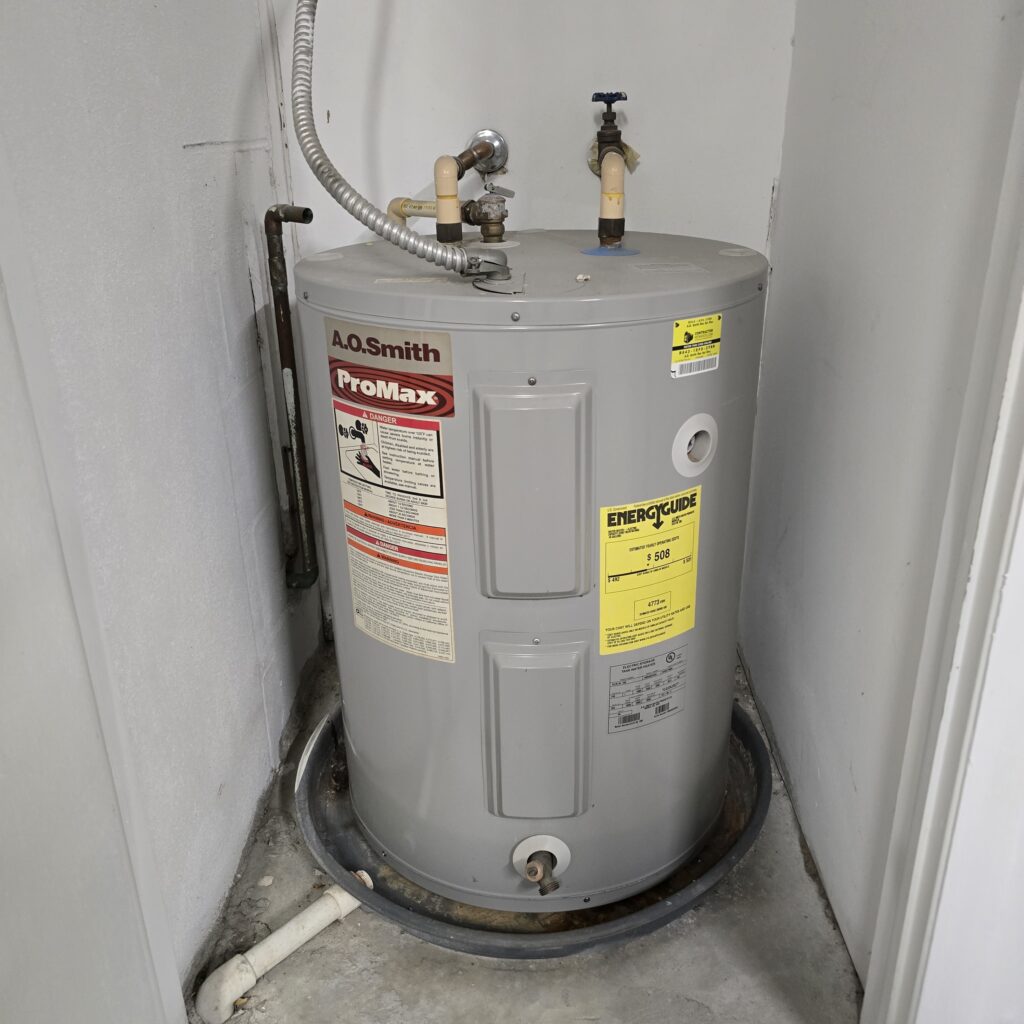
Homeowners with a healthy tank and a working drain valve can reasonably handle a routine flush. The task requires a garden hose, a safe place to discharge very hot water, and careful attention to the shutoff sequence from start to finish. Problems begin when the drain valve refuses to open, refuses to close, or clogs halfway through the process. A valve stuck open on a full tank is a genuine emergency, since the only way to stop the flow is at the cold inlet or the main shutoff. Attic installations raise the stakes considerably, because any mistake up there lands in the living space below. Knowing the limits of the job is part of doing it safely.
Certain conditions call for a licensed plumber from the very beginning. Tanks older than ten years, tanks that have never been flushed, and tanks showing rust around the fittings all deserve trained eyes before anything gets opened. Gas units with a pilot that will not relight, units producing a burning smell, or units with visible scorching near the flue need a plumber rather than a maintenance attempt. Tankless equipment requires a circulation pump, a descaling solution, and isolation valves, which puts it outside the range of a typical homeowner task. Homes with an expansion tank, a recirculation pump, or a thermostatic mixing valve add complexity that a full professional inspection handles properly. Calling a plumber costs far less than repairing water damage from a flush that went sideways.
There is a practical argument as well. A professional visit takes the task off your list entirely and produces documentation for your warranty file. The technician catches small failures early, like a weeping drain valve or a waterlogged expansion tank, and both are inexpensive to fix now and costly to fix later. You also get a straight answer about how much life the tank has left, which lets you plan a replacement on your schedule instead of reacting to a flood. Emergency work always costs more than scheduled maintenance. That gap is the entire argument for staying ahead of it. Dealing with a water heater that is already noisy, leaking, or short on hot water? Click here for our water heater repair service.
Why Choose Whitestone Plumbing for Your Water Heater Flush
Whitestone Plumbing is a locally owned and operated company based at 702 Dewberry Dr in Cedar Park, and we serve homes throughout Leander, Round Rock, Georgetown, Pflugerville, Austin, Jonestown, Lago Vista, and Hudson Bend. Our technicians bring over twenty years of plumbing experience to every appointment, and we are licensed, insured, and certified in backflow prevention. We understand the water in this area because we work in it every single day, and we size our maintenance recommendations to what your specific home actually needs. Free estimates come with clear, honest pricing, so you know the cost before any work starts. We are dedicated to delivering five star service on every visit.
We treat a water heater flush as a complete service appointment rather than a quick drain and refill. You get the sediment removed, the safety components tested, the expansion tank verified, and a straight assessment of your unit and its remaining life. If the tank has years left in it, we tell you that and we tell you when to schedule the next flush. If replacement turns out to be the smarter investment, we explain the reasoning clearly and give you options in writing. We never push equipment onto a home that does not need it.
Plumbing emergencies do not wait for business hours, so we answer calls twenty four hours a day, seven days a week. A ruptured tank or a failed connection gets a fast response and a permanent repair instead of a temporary patch. Call us at (512) 826-6217 or email info@callwhitestone.com to schedule your water heater flush before cold weather arrives. One appointment now protects your equipment through the busiest season of the year for hot water demand. We look forward to earning your trust and keeping your system running.